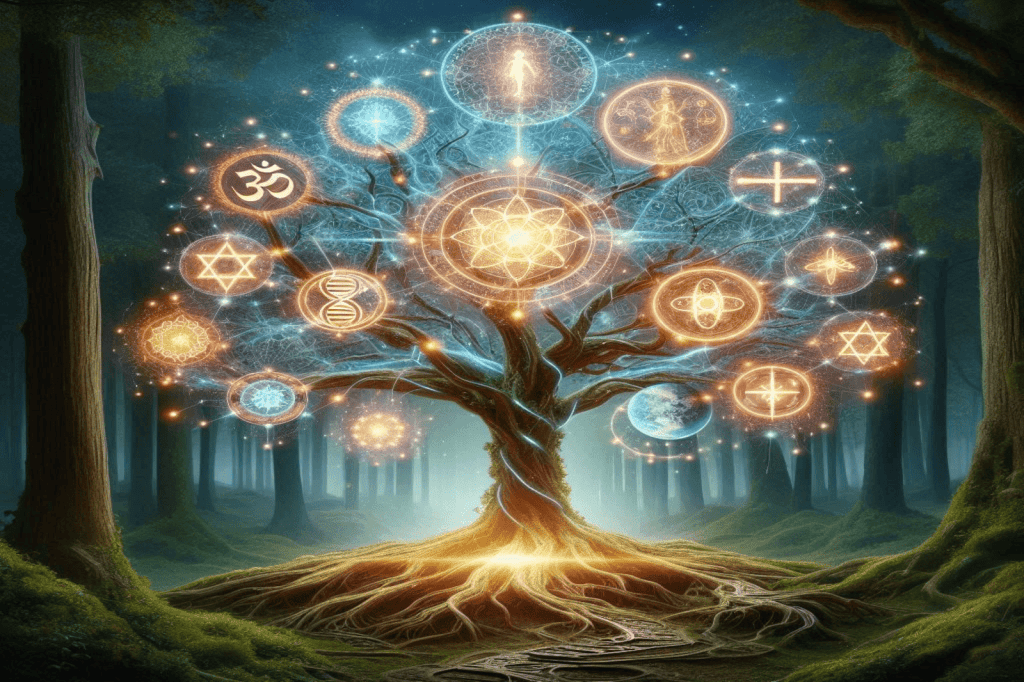
“All religions, arts, and sciences are branches of the same tree. All these aspirations are directed toward ennobling man’s life, lifting it from the sphere of mere physical existence and leading the individual towards freedom.”
— Albert Einstein
Tree of knowledge
Science and Spirituality both are branches of the same ‘Tree of Knowledge’ sustained by collective human curiosity. This tree embodies the innate human instinct to explore and expand our understanding. Science and Spirituality are like two branches growing at opposite ends but both moving with the same intent of embracing the metaphorical sun of universal truth — the truth about ‘Life, the Universe, and Everything‘ (also the title of the 3rd book in the HHGTTG series; one of my personal favourites). Both search for the truth in the vastness of the cosmos — ‘out there’ — and in the vastness of consciousness — ‘within us’ — simultaneously.
To a monkey who never ventures beyond the branch it calls home, both branches might seem worlds apart, but one should not mistake branches for the entire tree.
Modern Science
Modern science is based on the two fundamental principles – ‘Rationalism‘ and ‘Empiricism‘. The two words might sound complex but let me assure you that it is mostly due to the unfamiliarity of people with the philosophical jargons, and not due to their actual complexity. They are very simple to grasp.
Empiricism
Empiricism emphasises the importance of observations and experiments, and believes they are the only true source of knowledge and rejects any other source outside the realm of direct experience and sense perception. It believes in the concept of repeatable experiments as proof.
Rationalism
Rationalism somewhat contradicts empiricism, believing in reason and deduction as the true sources of knowledge, and emphasises the role of innate ‘ideas’ in our mind in gaining knowledge. One can not help but notice the irony of the contrast that the foundational blocks of science have in their approach to knowledge. And yet they both played their part in the development of science as an independent domain; empiricism helped in shaping the scientific methods of experimentation while rationalism heavily influenced how we formulate scientific theories.
Ancient Spirituality
Spirituality is based on the inner experience and sometimes goes beyond reasoning and sense perception. It emphasises your first -person experience and understanding of life and the world around you. People often equate spirituality with religion which could not be any further than the truth. Spirituality is a personal endeavour undertaken with the goal of self evolution based on self-experience, meanwhile religion is an organised social construct built around the culture of shared beliefs, rituals and customs. A religious person is one who believes while a spiritual person is one who seeks – the ultimate truth.
Common Grounds
The quest undertaken to seek and not to believe is where science and spirituality start seeing eye to eye. Both paths don’t take anything for granted—neither the words from scriptures nor the words from any figures of authority hold any weight in their courts. Only living proof that can be verified holds value in their courts. They both conduct experiments to decipher the truth and believe in seeking the answers on their own.
Subtle Difference
However, there is a subtle difference in terms of what science and spirituality consider valid proof. Science outright denies the existence of anything that cannot be measured or detected by us, but spirituality is a little more humble. It accepts that our sense perception might be limited, thus is open to the possibility that there are things that might exist beyond our perception. Regardless of this minute difference, there are some similarities in the approach taken by a scientist and a spiritual seeker. They both perform experiments to learn and grow; only the nature of their experiments varies slightly. A scientist uses empirical measures to observe the outcome of an experiment, while a spiritual seeker uses his own personal experiences as measures.
“The notion that science and spirituality are somehow mutually exclusive does a disservice to both.”
— Carl Sagan
Seeking Same Answers
Despite this minute difference, they both ask similar questions in their quest for knowledge, and many times arrive at very similar answers in their journey to seek the ultimate truth. Both are on a timeless quest to uncover the origin of the universe, the purpose of life, the true nature of reality & how we perceive it, the laws of ethics and morality, the human brain and psychology, and many other truths about us and the cosmos.
Convergence
1. Fundamental Forces
Unified Field Theory aims to bring together all four fundamental forces of the universe — Gravitational, Electromagnetic, Weak, and Strong Nuclear, into a single framework. This concept was introduced by none other than Albert Einstein, who dedicated much of his life to this pursuit. Essentially, modern science has been on a quest to unify these forces for over a century. This belief, which is the outcome of work that started in the 19th century with James Clerk Maxwell and later continued by Einstein in the 20th century, is also shared by many different spiritual philosophies.
The Vedantic school of non-dualism (Advaita Vedānta), which is based on the unity of matter and consciousness, suggests that the diverse forces we observe are just manifestations of a single and more fundamental force, which is the only force behind everything. Many other spiritual philosophies, such as Buddhist Śūnyatā (emptiness) philosophy, also share this idea of a single force behind the universe.
2. Nature of Reality – Quantum Physics
The field of Quantum Mechanics and Advaita Vedanta (Non-dual Vedanta), despite coming from two separate branches of the tree of knowledge, share a lot of similar conclusions about our universe and our consciousness. The Vedantic philosophy, which is also based on rigorous logic, could help to provide a philosophical framework to interpret many discoveries and phenomena such as the dual nature of matter and Quantum entanglement.
The dual nature of matter, first proposed by Louis de Broglie in 1923, is one of the fundamental principles of quantum physics, which states that matter and energy possess both the characteristics of a particle (imagine any object such as a tennis ball which you can touch and feel) as well as a wave (imagine light, sound, or even ripples over the surface of a pond – which is not actually matter but a form of energy, thus transient).
Moreover, the nature of the matter and energy — whether they show wave or particle behaviour — depends on our act of observation. They tend to act like particles when we observe them. Thus, according to quantum physics, the act of observation affects the object under observation itself. Advaita Vedanta takes this conclusion a step further and states that the process of observation influences both the observer and the object observed, affecting them both equally. Vedanta tells us about ‘vrittis’ —roughly translated into ‘mind-waves’. These “vrittis”, or ‘mind waves’, transform into objects, which we perceive all around us as the physical reality. Thus, according to Vedanta, both the object and the observer are interlinked and are manifestation of the same universal force.
“After the conversations of Indian Philosophy, some of the ideas of Quantum Physics that seemed so crazy suddenly made much more sense.”
— Werner Heisenberg
3. Nature of Mind – Psychology
If we look at Psychology which is a fairly new domain of science (born during the late 19th to early 20th century) but one which plays a crucial role in advancing our understanding of our mind and consciousness. It is perhaps the most important among all the domains of science concerned with understanding ourselves.
Initially, in the early stages of development of psychology as an independent field, it often emphasised more on observable phenomena and empirical methods, disregarding the role played by spirituality & personal beliefs on the psychology of a person. However later on during the 1950’s works of Abraham Maslow and many others gave rise to – humanistic psychology which focused on self – actualization & self – awareness and acknowledged spiritual aspiration as an integral part of the psyche.
Then came the positive psychology movement which started in 1998 with the works of Martin Seligman and others which recognized spirituality as a key component of psychological well-being. And emphasised spirituality in making a person resilient and better able to cope with adversity. Today, spirituality therapy is flourishing and is seen as an effective tool to address existential concerns like the search for meaning, feelings of disconnect, or dealing with mortality. Not only this, but today there is also great demand by psychologists for the inclusion of spirituality in the fold of psychology for the exploration of human behaviour, and growth.
Final Words
“Religion and science are the two wings upon which man’s intelligence can soar into the heights, with which the human soul can progress. It is not possible to fly with one wing alone! Should a man try to fly with the wing of religion alone he would quickly fall into the quagmire of superstition, whilst on the other hand, with the wing of science alone he would also make no progress, but fall into the despairing slough of materialism.” ~ Abdu’l-Bahá
No words can better capture the entangled relationship of Science and Spirituality and their place in our lives better than those said by Abdu’l-Bahá. Science and Spirituality are not exactly the same, and neither one could replace the other; the fact of the matter is — there is no need for that. Both are the outcomes of never-ending human thirst for knowledge and our eternal curiosity. Both seek the same truth i.e. the answer to Life, the Universe and Everything. And both in many ways work for the good of humanity and try to make our lives better. Thus, we should strive to achieve harmony between science and spirituality.




 Curious Corner
Leave a comment