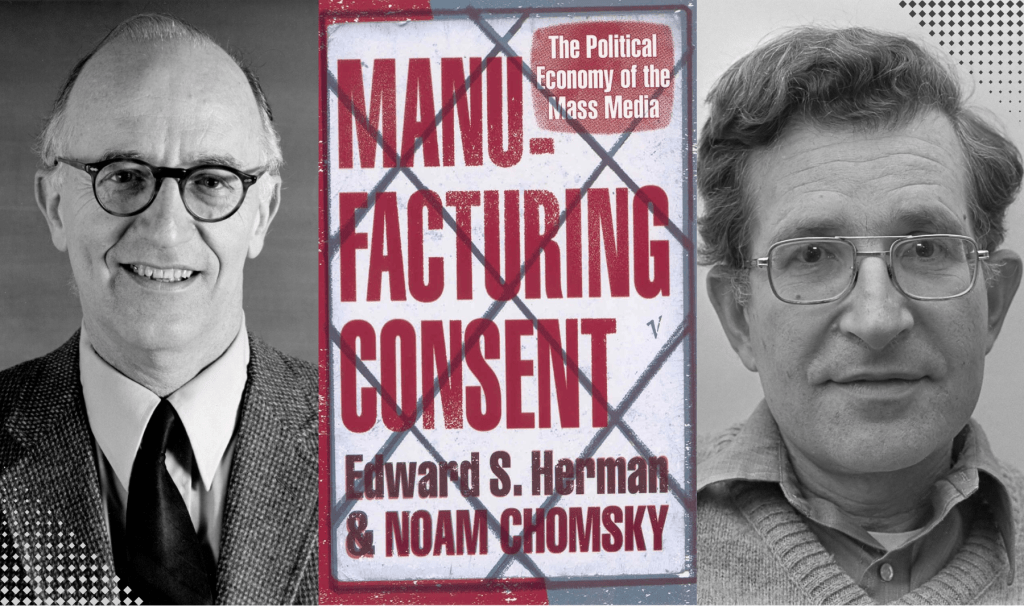
“It is the responsibility of intellectuals to speak the truth and expose lies.”
― Noam Chomsky
The Propaganda Model of communication, given by Edward S. Herman and Noam Chomsky in their famous book Manufacturing Consent, published in 1988, offers a critical framework for understanding how mass media actually serves the interests of powerful elites rather than providing objective information. And how instead of supposedly acting as the fourth pillar of democracy they serve as the tool for spreading propaganda in the interest of the controlling elites.
The model identifies five key filters — ownership, advertising, sourcing, flak, and social control mechanisms — that are designed to filter and shape the media content and influence public opinion. It was initially developed to critique traditional media like television, newspapers, and radio, however in my opinion the model has only proved to be even more relevant in the digital age. As today the tendrils of social media platforms reach far deeper into our lives than any traditional media could even dream to reach. It has permeated through every aspect of life, it is everywhere around us and is taking more and more of our attention and headspace. People have become hooked to these platforms and for some it has even reached the point of addiction.
The Five Filters
1. Ownership
Media outlets are often large, profit-driven corporations that prioritize the interests of their owners, shareholders, and investors. This filter suggests that these companies are unlikely to challenge the political or economic systems that benefit their stakeholders. Instead, they promote narratives that align with elite interests. In the digital age, corporate consolidation of tech companies such as Facebook, Google, and Amazon now plays a crucial role in shaping what news is delivered and how it is consumed. Their control over vast communication platforms allows them to subtly reinforce dominant ideologies that suits their interests.
2.Advertising
Most media outlets rely heavily on advertising revenue, which acts as a kind of “license to operate“. Media companies avoid reporting news that could alienate major advertisers, leading to editorial bias. In the context of digital media, this filter becomes even more pronounced, as platforms like Facebook and Google thrive on advertising models that promote content based on engagement rather than its factual accuracy. Algorithms favor sensationalist or ideologically driven content because it generates more clicks, views, and shares—leading to more advertising revenue.
3.Sourcing
News organizations depend on reliable, routine sources of information—often government officials, corporations, and major institutions. These sources act as the “gatekeepers“, providing access to news and controlling what stories are told to the masses. Independent voices and minority perspectives struggle to gain visibility in this landscape.
This filter is evident in coverage of global events like the 2022 Ukraine-Russia War, where mainstream outlets often relied on government statements and official sources. This type of sourcing inevitably skews coverage in favor of established and dominant stakeholders, making it harder for dissenting views or smaller actors to enter the larger narrative.
4.Flak
“Flak” refers to negative feedback a media organizations receive when they publish stories that challenge powerful interests. This can take the form of lawsuits, regulatory pressures, or organized criticism from lobby groups. In the digital age, flak has evolved to well orchestrated online campaigns, where coordinated efforts on social media can amplify or suppress specific viewpoints.
For instance, during the Israel-Gaza War, media outlets faced intense online backlash from both sides of the conflict. Governments, activist groups, and social media users applied pressure to influence the narrative and silence unfavorable reports.
5.Social Control Mechanisms
In the original Propaganda Model, anti-communism was the dominant social control mechanism, used to rally public opinion in US against perceived enemies. In the post – 9/11 era, this has shifted to the “War on Terror.” Today, fears related to terrorism, security, and “fake news” serve as modern control mechanisms.
In the digital sphere, social media companies are tasked with moderating content in ways that align with national security interests or corporate policies. This filter can be seen in how social media platforms handle content related to the election misinformation, prioritizing certain narratives while suppressing others, often under the guise of maintaining public safety or fighting disinformation.
How Social Media Amplifies the Propaganda Model
Social media platforms like Facebook, Twitter, and YouTube use algorithms that prioritize content based on engagement, often amplifying sensationalist or ideologically charged material. This aligns with the filters of the Propaganda Model.
For example, during the 2022 Ukraine-Russia War, Western platforms amplified anti-Russia content, while Russian state media pushed pro-Russian narratives. Similarly, in the Israel-Gaza War, media coverage and social media posts varied based on regional and political biases, using viral and many times even fake content to sway public opinion.
Additionally, tech giants like Google and Facebook control much of the digital landscape, influencing which stories are promoted, echoing the Propaganda Model’s filter of ownership. Their control over content distribution and moderation profoundly shapes public discourse.
Possible Solutions
In a world where both the traditional and the digital media — are influenced by powerful interests, the Propaganda Model is more relevant than ever. Understanding the five filters helps us to critically analyze the news and identify biased narratives shaped by corporate or political agendas. And with the power of social media they are taking more and more of our attention.
However, the same technology can also play a role in fighting back the propaganda. The democratization of technology—where nearly everyone has internet access and smartphones—allows individuals to share alternative perspectives and challenge dominant narratives through social media. For example, during the Arab Spring in 2010-2011, citizens across the Middle East used platforms like Twitter and Facebook to organize protests, share on-the-ground footage, and bypass state-controlled media. This grassroots movement spread awareness globally, eventually leading to political changes in several countries.
Similarly, during the Black Lives Matter protests in the U.S. and worldwide, activists used social media to amplify their message, share videos of incidents, and rally support, often counteracting the narratives presented by traditional media outlets. By using these platforms, individuals were able to challenge the status quo and bring attention to issues that were underrepresented or misreported.
In conclusion, Herman and Chomsky’s Propaganda Model remains highly relevant after being introduced some 36 years ago. And I would argue that their relevance has even increased in the digital age, where social media and algorithms have amplified the five filters model. The five filters continue to shape media content, serving elite interests and influencing public opinion. However, technology also empowers individuals to challenge dominant narratives, as seen in movements like the Arab Spring and Black Lives Matter.
Media literacy and awareness of this five filter model are keys to resisting the propaganda ran by controlling elites. And being able to make more informed opinions. Always remember only you yourself can best serve your own interest other are mostly there to play their own game. So always try to read between the lines and see between the pixels as there will always be these five filters acting on most of the content that will reach you. And never make opinion in haste take as much times as needed for real picture to emerge. Then only make well informed opinions.





 Curious Corner
Leave a comment