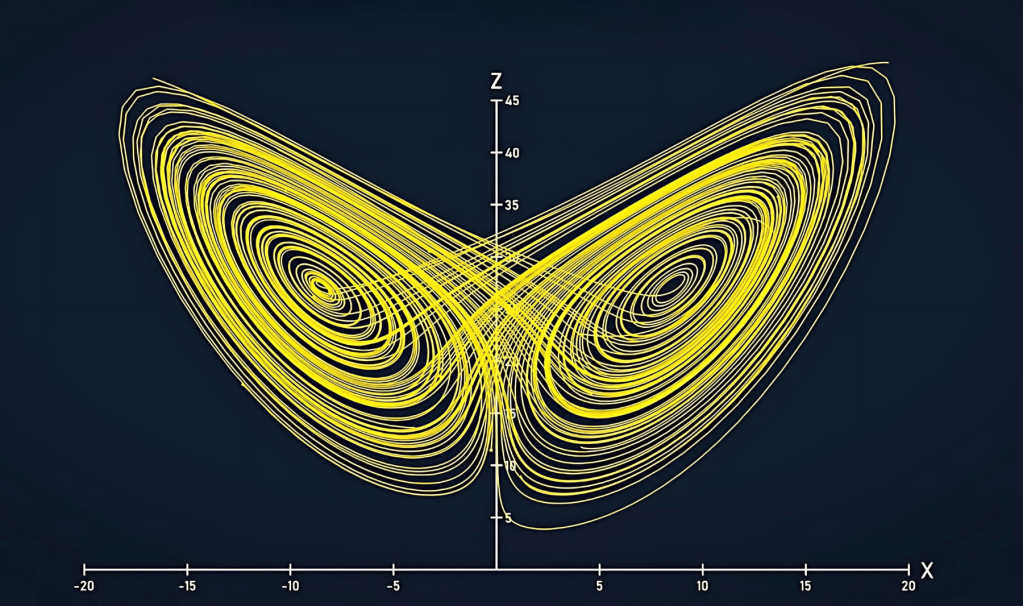
“They say that if a butterfly flaps its wings in the Amazonian rainforest, it can change the weather half a world away. Chaos theory.
― Catherine McKenzie, Fractured
Can the flap of a butterfly’s wings in Brazil set off a tornado in Texas? While it might sound nonsense, this question illustrates a key concept in chaos theory—the idea that small changes can lead to vast, unpredictable outcomes.
Chaos theory, a branch of mathematics, deals with systems that seem random yet follow specific, deterministic rules. Though these systems are governed by mathematics, they behave in ways that appear chaotic and unpredictable. From weather patterns to stock markets, chaos theory has helped scientists make sense of complex, seemingly disorderly phenomena.
Chaos Theory
Chaos theory is a field of mathematics that explores how very small changes in the starting conditions of certain systems can lead to wildly different outcomes. In simpler terms, it shows how minor variations in input can cause dramatic changes in output, making it nearly impossible to predict the future behavior of these systems over long periods.
For instance, when trying to predict the weather, a seemingly insignificant factor like a small gust of wind today can lead to drastically different weather conditions a week later. This sensitivity to initial conditions, known as the “butterfly effect”, is a central idea in chaos theory.
Although chaos theory might seem like it’s describing randomness, it’s actually governed by deterministic rules—meaning if you knew every detail about a system’s starting conditions, you could predict its behavior. But, in practice, the sensitivity to small changes makes this kind of prediction almost impossible.
The Butterfly Effect
One of the most famous examples of chaos theory is the butterfly effect, which suggests that something as small as the flap of a butterfly’s wings could create tiny disturbances in the atmosphere that grow into large-scale events like a hurricane. While this metaphor may exaggerate the point, it highlights a core idea: in chaotic systems, small actions can have enormous, unpredictable consequences.
Think of a ripple in a pond. When you toss a pebble, the ripples it creates spread out and affect the entire surface of the water. But imagine that instead of a calm pond, you’re dealing with a turbulent sea—small changes in one spot could cause unpredictable and large-scale changes somewhere else. This helps explain why predicting the weather beyond a few days is so difficult: tiny, almost imperceptible changes in one part of the system can completely alter the outcome.
Chaos in the real world
Chaos theory doesn’t just belong in the realm of abstract mathematics; it has played a pivotal role in shaping human history. Seemingly minor events, chance encounters, and split-second decisions have often triggered monumental changes, leading to wars, revolutions, and societal reforms. Nowhere is this more evident than in the onset of the World Wars—where a single wrong turn forever altered the course of human history.
A Wrong Turn That Sparked World Wars
It was a calm summer day in Sarajevo, June 28, 1914. The streets were buzzing with excitement as Archduke Franz Ferdinand, heir to the Austro-Hungarian throne, paraded through the city with his wife, Sophie. They were on a goodwill tour, visiting the provinces of their vast empire. No one knew that this day would mark the beginning of events that would change the world forever.
Earlier that morning, a group of Serbian nationalists had planned an assassination. They were desperate to free their homeland from Austro-Hungarian control. One of the assassins threw a bomb at the Archduke’s car but missed, injuring bystanders instead. Franz Ferdinand, shaken but unharmed, continued with his visit, thinking the worst was behind him.
But here’s where a small, seemingly insignificant decision altered the course of history.
After the failed bomb attack, the Archduke insisted on visiting the hospital to check on those injured in the explosion. His driver, unfamiliar with the city, made a wrong turn onto a narrow side street called Franzjosefstrasse. This was a mistake—one that would echo across the globe. As the car stopped to reverse back on track, a young man named Gavrilo Princip, one of the would-be assassins, happened to be standing on that very street.
Seizing the unexpected opportunity, Princip stepped forward, drew his pistol, and fired two fatal shots—killing both Franz Ferdinand and his wife, Sophie. It was a random encounter, the result of a simple wrong turn, but it set off a chain of events that the world could not undo.
The assassination of Archduke Franz Ferdinand became the spark that ignited World War I. In response to the killings, Austria-Hungary issued an ultimatum to Serbia, and when Serbia’s response was unsatisfactory, Austria-Hungary declared war. A complex web of alliances between European powers quickly dragged Germany, Russia, France, and Britain into the conflict. The world was plunged into a war that lasted four years, claimed millions of lives, and reshaped entire nations.
But the ripple effect didn’t stop there.
The devastation of World War I created the conditions for political upheaval across Europe. In Russia, the war weakened the Tsarist regime and led to the Russian Revolution of 1917, which eventually gave rise to the Soviet Union. In Germany, the harsh terms of the Treaty of Versailles, which ended the war, left the country humiliated and economically crippled—fertile ground for the rise of Adolf Hitler and the Nazi Party.
Just over two decades later, the world would once again be engulfed in war—World War II—a direct consequence of the unresolved tensions from the first.
In conclusion, chaos theory teaches us that even the smallest actions can lead to unpredictable and far-reaching consequences, both in mathematics and the real world. From weather patterns to world wars, the butterfly effect illustrates how seemingly insignificant events can cascade into monumental changes.
Understanding the delicate balance between order & chaos, gives us gain deeper insight into the complex, interconnected nature of our world, where every decision—no matter how minor—has the potential to alter the course of history.
This is not only true for macro level but also for our individual lives. Look back into your past and try to find these ‘what- if‘ events, the smallest of the incidents that shaped your life and made you who you are today. They defines what you do, what you like and who you are with and all. And most of the times you would realize these were random chance event beyond your control. Only at some few point in our life we force order and make some key decisions that give a new turn to our journey. In this way our life too is chaos and people who embrace this chaos are the ones who enjoy this roller-coaster ride the most. So, don’t try to fight chaos with order let them do the dance of life.






 Curious Corner
Leave a comment