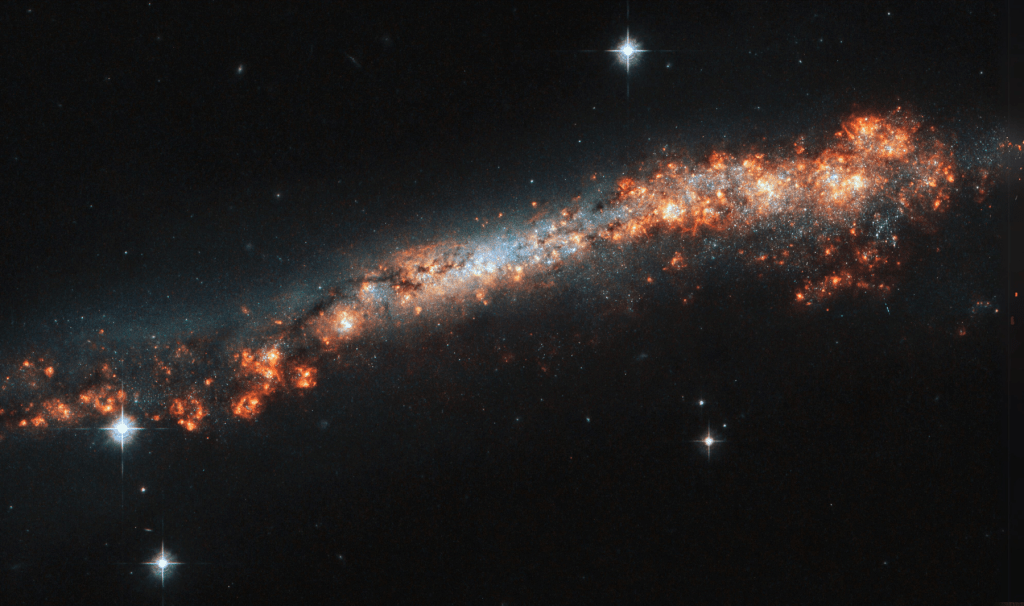
“In terms of the most astonishing fact about which we know nothing, there is dark matter and dark energy. We don’t know what either of them is. Everything we know and love about the universe and all the laws of physics as they apply, apply to four percent of the universe. That’s stunning.”
― Neil deGrasse Tyson
We marvel at the stars, planets, and galaxies that fill our universe, but what if I tell you that the vast majority of it is something we can’t even see? In fact, 95% of the universe is invisible, composed of mysterious substances called dark matter and dark energy. But what if I told you that 95% of our universe is actually hidden from our eyes, made of things we can’t directly see or touch? These unseen forces are known as dark matter and dark energy, and they hold the key to the universe’s biggest mysteries.
Dark Matter
Most of us think the universe is made up of things we can see: stars, planets, and cosmic dust. But scientists have discovered that there’s something much more — dark matter, an invisible substance that makes up about 27% of the universe.
Imagine you’re holding a balloon. The air inside is invisible, but you know it’s there because it keeps the balloon inflated. In the same way, dark matter exists because its gravitational pull holds galaxies together, even though we can’t see it.
Without dark matter, galaxies would fall apart. Its gravitational pull helps give the universe its structure, like an invisible skeleton holding everything in place.
Dark Energy
If dark matter is the glue that holds the universe together, dark energy is the force pushing it apart. Discovered in the 1990s, dark energy is thought to make up a whopping 68% of the universe. It’s the mysterious force driving the accelerated expansion of the universe.
Imagine you’re blowing up a balloon. As you add more air, it expands faster and faster. Dark energy works similarly, but on a cosmic scale—it’s causing the universe to expand more quickly over time.
This accelerated expansion is one of the biggest mysteries in cosmology. If we can understand dark energy, we might unlock answers about the fate of the universe — whether it will continue expanding forever or collapse in a “Big Crunch“.
Dark Discovery
If we can’t see dark matter or dark energy, how do we know they’re out there? Scientists use indirect evidence. It is like inferring the probability of a fire by spotting smoke.
We know dark matter exists because of its gravitational effects on galaxies. Stars at the edges of galaxies are moving too fast to be held by visible matter alone. Dark matter’s gravity keeps them from flying away.
Scientists discovered dark energy when they noticed that distant galaxies were moving away from us faster than expected. The expansion rate of the universe was accelerating, something only a mysterious force like dark energy could explain.
Why Should You Care?
Even though dark matter and dark energy might seem like abstract ideas, they’re crucial for understanding the universe. They represent our frontier in physics—the next big puzzle to solve. Imagine what other mysteries they could unlock about the origins and future of the cosmos.
Future Technology
In a future shaped by breakthroughs in dark matter research, we could witness transformative advancements in technology and space exploration. Envision a spacecraft powered by a revolutionary dark matter engine, capable of harnessing the immense energy from dark matter to achieve speeds close to the speed of light. This innovation would shorten interstellar journeys, making destinations like Proxima Centauri reachable within years instead of millennia.
Additionally, dark matter’s unique properties could inspire the development of ultra-efficient energy sources, potentially replacing fossil fuels and ushering in a new era of sustainable living. Beyond these practical applications, the study of dark matter might lead to unforeseen technological advancements, influencing fields like materials science and quantum computing.
As we delve deeper into the mysteries of dark matter, we stand on the brink of a new scientific frontier. The discoveries we make could not only expand our understanding of the universe but also bring science fiction closer to reality, transforming the way we live and explore the cosmos.
Dark matter and dark energy remind us that science is full of wonders waiting to be explored. Even though we can’t see or touch these invisible forces, their presence shapes the universe in ways we’re just beginning to understand. The more we learn about them, the closer we get to answering one of humanity’s oldest questions: What is the universe really made of?






 Curious Corner
Leave a comment