
“If a coin comes down heads, that means that the possibility of its coming down tails has collapsed. Until that moment the two possibilities were equal. But in another world, it does come down tails. And when that happens, the two worlds split apart.”
― Philip Pullman, The Golden Compass
Imagine stepping into a realm where the laws of physics are different, where every decision you make spawns a new universe. Welcome to the multiverse—a concept that stretches the boundaries of our understanding of reality. The multiverse theory proposes that our universe is just one of many, each with its own unique set of physical laws and realities.
One of the foundational ideas supporting this theory is the Many-Worlds Interpretation (MWI) of quantum mechanics. According to MWI, every quantum event leads to the creation of multiple, branching universes. For instance, imagine a scenario where you decide to take a different route home from work. In one universe, you arrive home safely, while in another, you encounter an unexpected adventure. Each choice and outcome leads to the birth of a new universe, unfolding its own unique story.
Cosmology provides further support for the multiverse theory through the concept of bubble universes. The idea is that our universe is one bubble in a vast, cosmic foam of multiple universes, each separated by a boundary of its own. Picture these bubbles drifting in an infinite sea, each with its own set of physical constants and properties. These cosmic bubbles might collide or remain isolated, each a distinct reality unto itself.
The philosophical implications of the multiverse are profound. If there are infinite universes, then every possible scenario, every choice you didn’t make, exists somewhere. This notion challenges our understanding of fate and free will, suggesting that every possibility is played out somewhere in the multiverse.
“However, one new theory says that dark matter may be ordinary matter in a parallel universe. If a galaxy is hovering above in another dimension, we would not be able to see it. It would be invisible, yet we would feel its gravity. Hence, it might explain dark matter.”
― Michio Kaku
The Science Behind Parallel Universes
But how solid is the scientific foundation for parallel universes? The idea may sound like science fiction, but there’s substantial theoretical backing. Quantum mechanics and the Many-Worlds Interpretation provide one perspective. MWI suggests that every quantum event splits the universe into different branches, each representing a different outcome. Imagine you’re facing two choices — one leads to success, the other to failure. According to MWI, both outcomes occur, each in its own parallel universe.
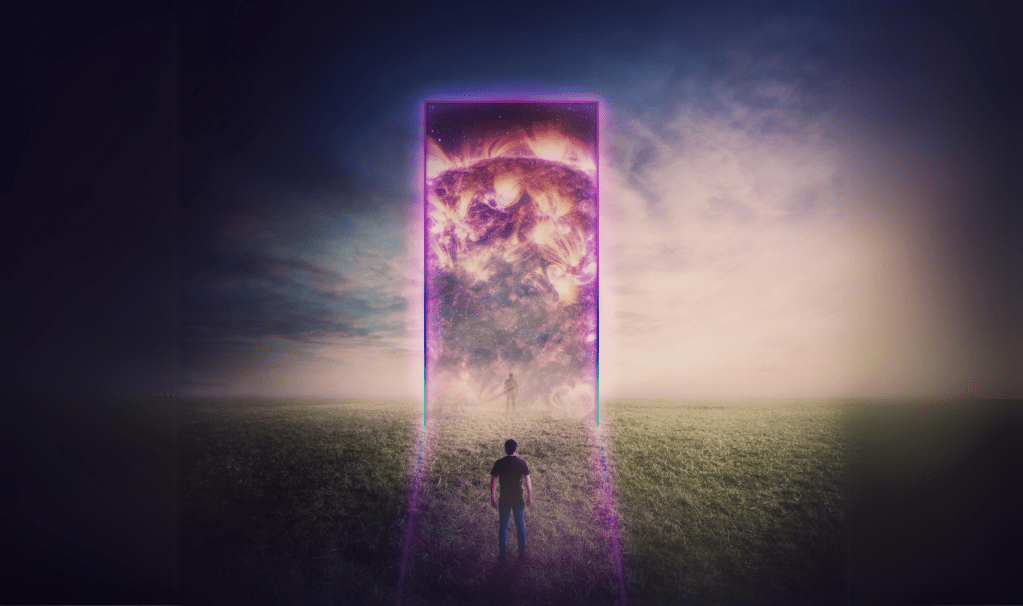
String theory adds another layer to this concept by proposing the existence of extra dimensions beyond our familiar three-dimensional space. These extra dimensions could harbor parallel universes, each with different properties and physical laws. Envision a scenario where you can travel through these extra dimensions, moving between different universes as easily as walking through a door.
Real-world experiments and observations also provide tantalizing hints of parallel universes. For example, anomalies in cosmic background radiation might suggest interactions with other universes. Additionally, some theories propose that dark matter could very well be normal matter interacting with a different universe. Although direct evidence remains elusive, ongoing research and technological advancements could one day confirm the existence of these parallel realms.
“Science fiction has a profound impact on our understanding of science. It stimulates curiosity and drives the imagination, making complex scientific concepts accessible and engaging to the public.”
― Anonymous
Parallel Universes in Sci-Fi
Science fiction has long explored the concept of parallel universes, blending imagination with scientific speculation. In Philip K. Dick’s The Man in the High Castle, alternate histories are portrayed, showing what might have happened if different outcomes had occurred in World War II. This exploration of parallel worlds invites readers to ponder how small changes can lead to vastly different realities.
The animated series Rick and Morty takes a more humorous approach, with characters traveling through various universes filled with bizarre and often chaotic scenarios. The show’s portrayal of multiverses combines scientific concepts with creative storytelling, reflecting the endless possibilities that the multiverse theory suggests.
Doctor Who has also delved into parallel universes and time travel, creating a rich tapestry of alternate realities and future possibilities. The series showcases how different universes can intersect and interact, influencing our understanding of both fiction and science.
Science fiction doesn’t just entertain; it inspires and shapes public perception of scientific concepts. By exploring the multiverse through imaginative storytelling, these works encourage curiosity and exploration, bridging the gap between science and popular culture.
In closing, what once seemed like pure science fiction—the idea of a multiverse—is now a topic of serious debate in both scientific and philosophical circles. The Many-Worlds Interpretation and string theory offer theoretical support, while popular culture tempts us to imagine infinite versions of reality. From quantum mechanics’ branching realities to bubble universes drifting in the cosmic expanse, the multiverse forces us to reconsider existence, free will, and the very fabric of reality. As research pushes the limits of what we know, the multiverse remains an intriguing, albeit speculative, frontier—where the lines between science, imagination, and what we think is possible continue to blur.
At the end, will time unveil the secrets of reality and the universe, or will time itself prove to be an illusion? Who knows?





 Curious Corner
Leave a comment